
Fluidline
The dead man handle: A ball valve that closes when you let go
A standard lever ball valve stays where you leave it. That is exactly what you want on an isolation valve, and exactly what you don’t want on a drain, a sample point or a dispensing line. An operator opens the valve, gets called away, and the line keeps running until someone notices.
A dead man handle, also called a spring return handle, solves this mechanically. The operator has to hold the lever against a spring to keep the valve open. Release it, for any reason, and the spring drives the ball back to its rest position. No power, no air supply, no instrumentation and no procedure to remember.
If nobody is holding the handle, the valve is shut. That is the whole design.
How it works
The spring return handle replaces the standard lever on a quarter-turn ball valve. A stainless steel spring inside the handle is anchored to the valve’s mounting pad and loaded as the handle is turned to open. The stored energy returns the handle, and with it the ball, to the closed position as soon as the operator lets go.
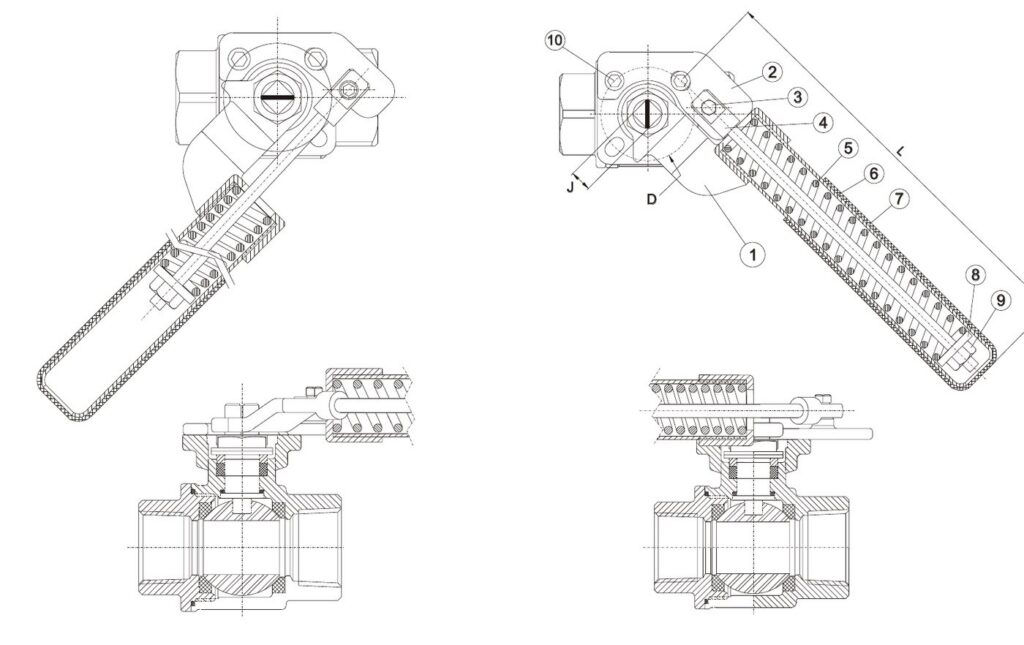
From the SH01 data sheet. Left: open condition, handle held against the spring. Right: close condition, where the spring returns the handle on release. Item numbers refer to the materials list below.
Because the handle mounts on the valve’s ISO 5211 top pad, it is a bolt-on part and not a special valve. The valve underneath is the same 2 piece, 3 piece or flanged ball valve you already know, with the same body, ball, seats and pressure rating.
Where a dead man handle belongs
Fit one anywhere the valve should only be open while a person is physically present and paying attention:
- Sample points on process lines, where the operator fills a bottle or bomb and must not leave the point flowing.
- Drains and low point bleeds on vessels, filters, strainers and level gauges.
- Vents and blowdowns on gas, steam and compressed air systems.
- Aviation fuelling. The SH01 is in service on aviation and jet fuel tanks at major airports worldwide.
- Hazardous media, where flow should only continue while a person is present and must stop immediately if they are not.
- Mobile and high-vibration equipment such as tankers and refuelling trucks, where anti-loose NYLOK nuts keep the handle assembly secure.
- Dispensing and decanting of fuels, lubricants, solvents and chemicals into drums, IBCs and day tanks.
- Tank and bund drains, where a valve left open means lost product or a spill.
- Wash-down and utility points where water or air is otherwise left running.
The common thread: in every one of these duties the cost of the valve being left open is far higher than the cost of the valve. A spring return handle turns “remember to close it” from a procedure into a property of the hardware.
The SH01 spring return handle
The SH01 spring return handle is supplied by Fluidline. It is a heavy duty stainless steel handle assembly, designed for long term operation, that mounts directly to the ISO 5211 pad on threaded (BSP and NPT) and flanged ball valves.

The SH01 handle assembly: investment cast head, spring housed in the handle extension, PVC sleeve.
Key specifications
-
- Size range: the SH01 series covers valves from 1/4″ to 4″ (DN08 to DN100). The data sheet table below covers 1/4″ to 2″; ask us about larger sizes.
- Torque: up to 100 Nm across the series, adjustable by setting the spring nuts.
- Mounting: ISO 5211 direct mounting pad, so the handle is fitted or replaced without disturbing the valve.
- Construction: investment cast stainless steel (CF8 / CF8M) with stainless steel spring and fasteners, and NYLOK anti-loose nuts to resist vibration.
- Locking: locking function to prevent unauthorised operation.
| Valve size | Handle length L (mm) | Stem square J (mm) | ISO 5211 pad | Torque (Nm |
|---|---|---|---|---|
| 1/4″ – 3/4″ | 170 | 9 | F03 / F04 | 15 |
| 1″ – 1 1/4″ | 220 | 11 | F04 | 22 |
| 1 1/2″ – 2″ | 280 | 14 | F05 | 35 |
Materials
| Item and part | Material |
|---|---|
| 1. Handle head | CF8 (cast 304 stainless steel) |
| 2. Anchor | CF8M (cast 316 stainless steel) |
| 3. Anchor screw | SS 316 |
| 4. Spring rod | SS 316 |
| 5. Spring | SS 301 |
| 6. Handle extension | SS 304 |
| 7. Sleeve | PVC |
| 8. Washer | SS 304 |
| 9. Hex nut | SS 304 |
| 10. Socket head screw | SS 304 |
Why a separate handle matters
Because the SH01 is a handle assembly and not a dedicated valve, it changes how you stock and maintain these points:
- Stock valves and handles separately. One handle size covers several valve sizes, so a small number of handles converts valves you already hold.
- Replace the handle, not the valve. If a spring or lever is damaged, the handle is changed without removing the valve from the line.
- Retrofit existing points. A valve with the matching ISO 5211 pad can be upgraded to spring return duty.
- Add a lock where you need one. A hook and barred plate take a padlock, so the valve can be secured against unauthorised operation.
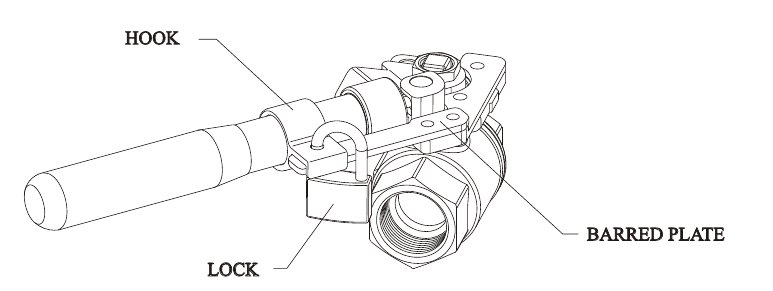
SH01 spring return handle with locking devices: hook, barred plate and lock.
Six things to get right when you specify one
- Confirm spring-to-close suits the duty. The SH01 shuts the valve when released. Make sure closed is the safe state for that point in the process.
- Match the mounting pad and stem. The valve needs a square stem and an ISO 5211 pad that match the table above. One handle fits different valve types that share the same pad and stem
- dimensions. Some configurations need a stem extension.
- Leave room to swing. The handle is 170 to 280 mm long and has to travel a full quarter turn. Check for clashes with pipework, insulation and structure.
- Set the spring torque. The spring’s output torque must exceed the valve’s break torque, with a safety factor. The spring nuts are adjustable, so set enough torque to close the valve reliably at
- line pressure without making the handle harder to hold than it needs to be.
- Think about the operator. The lever must be held against the spring for the whole operation. On a long drain or fill, position the valve so that can be done comfortably and safely.
- Consider closing speed. A spring return closes quickly. On liquid lines, particularly long ones, check that a fast closure won’t cause pressure surge.
What a dead man handle is not. It is not an emergency shutdown valve. It protects against a manual valve being left open by the person operating it. Where a valve must close on a process signal, a fire or a loss of utilities, you need an actuated valve with a fail-safe spring return actuator.
Never defeat it. A spring return handle that has been wired, taped or propped open is a standard lever valve with a false sense of security. If operators are tying it back, the task is taking too long for a hand-held valve and the installation needs another look.
Specify it with Fluidline
Fluidline supplies SH01 spring return dead man handles on 2 piece and 3 piece threaded ball valves in BSP and NPT, and on flanged ball valves. Tell us the valve size, end connection, line medium and operating conditions, and our technical team will match the handle to the right valve series.


